
Mississippi Sources for Previous Residents
Tracing past residents at a Mississippi address takes patience and a few good records. This Mississippi residents directory page explains the route. Start with the parcel and its legal description, then work backward through the deeds tied to that land. Old city directory volumes can attach a household name to a stretch of years. Census schedules can do the same. Maps, permits, newspapers, and probate files help fill gaps. Each source has limits. An owner is not always an occupant. Street names change while the parcel stays the same. Matching dates across independent records makes the history far more reliable. Property rolls and voter rolls both help there. Whether you want to find who lives at an address in Mississippi or who lived there decades ago, the same records carry the story.
| Source | Years It Covers | Where Held | What It Shows |
|---|---|---|---|
| County land roll and parcel | Current records; county coverage varies | County Tax Assessor and GIS | Owner, situs, mailing address, parcel, and legal description |
| Deeds and deed index | County-specific; online cutoffs vary | County Chancery Clerk; courthouse terminal or hard copy | Ownership changes and the legal description |
| Coast reverse directories | 1986–95; 1997; 2000–01; 2004 | Harrison County Library local history | Address-to-occupant or business clues for listed years |
| Federal census | 1790–1950 public after 72 years | National Archives and digital partners | Household members and year-specific context |
| State census and county tax rolls | 1818–1880; 1818–1902 | MDAH | Historical names and taxable-property context; completeness varies |
| Sanborn maps | 1880s–1920s/30s, by city; Jackson 1904 | Library of Congress and local libraries | Street and building footprint, not occupants |
| Permits and certificates of occupancy | Local dates and coverage vary | City or county planning office | Work, permit dates, and named applicant when recorded |
For a recent ownership change, start with the current parcel and the county Chancery Clerk. For an older household, pick a directory or census year near the date in question. Then test it against deeds, maps, probate, or a newspaper item. The 1904 Jackson Sanborn set runs to 25 sheets. It shows building footprints and street context, not the people inside. A county tax roll can establish that someone owned taxable property in a given year. It is not a census of who lived in the home. Property rolls answer ownership questions. Household questions need different records.
Mississippi Resident Address to Parcel
Start with the county where the land sits. Mississippi has 82 counties and no statewide recorder index. The Secretary of State's State and County Directory routes readers to the correct assessor. It also routes them to the right Chancery Clerk. Some counties keep more than one judicial-district seat. Confirm which office holds the record before sending a request. A county assessor or GIS card can connect a street address with a parcel number. It can also supply the legal description.
Keep three address fields separate. The situs address is where the parcel lies. The mailing address is where tax notices go. It may point to an owner living elsewhere. The legal description names a lot, block, subdivision, section-township-range, or metes-and-bounds tract. That description stays useful long after a street is renamed or renumbered. An assessor's owner field is an ownership clue, not a roster of past residents.
Use the Mississippi State and County Directory to identify the county office serving the parcel. County portals and field names vary. Follow that office's current instructions for a parcel card or public terminal.
Mississippi Previous Residents in Deed Books
County Chancery Clerks hold the land records for their counties. A deed index can walk you from the current owner back to an earlier seller. Each deed is its own step in the chain. There is no common statewide online start year. A grantor gives an interest in land; the grantee receives it. The chain of title is the sequence of recorded transfers linking those interests across time. Match each document to the parcel's legal description. That keeps the chain on the same land throughout.
- Copy the current owner, parcel number, situs address, and full legal description from the county assessor’s record.
- Search the county Chancery Clerk’s grantor-grantee index for the owner as grantee near the likely purchase date.
- Record the document number, book and page, recording date, grantor, grantee, document type, and legal description shown.
- Read the deed. Search the seller, now the prior owner, as grantee to find the earlier transfer.
- Repeat backward, checking each legal description and spelling variant; move to the official courthouse terminal, hard copy, or archive when the online index stops.
- Grantor / grantee
- The party transferring a recorded interest / the party receiving it.
- Chain of title
- The linked series of recorded ownership transfers for the parcel.
- Legal description
- The land description used in an instrument; it can outlast a street label.
- Criss-cross directory
- A dated reverse list arranged by street or address, useful for a past occupant clue.
- Enumeration district
- A defined area assigned to a census taker for a particular census year.
Ownership documents come in many forms: deeds, estate distributions, tax-sale deeds, foreclosure transfers, quitclaims, deeds of trust and releases, and plats. They do not all carry the same weight. Keep a short note on each document, and never treat a lien or tax-sale application as proof that a named person actually lived at the parcel.
Mississippi Past Residents and Deed Index Limits
Madison County offers a clear warning about online copies. Its Chancery Clerk page lists historical deed books from 1828 through 1988. Yet the same notice states that land records before January 1, 2000 are official only in hard copy. The same rule applies to official courthouse terminals. Online material serves as a convenience copy even when the image opens cleanly. A book's date range alone does not tell you which version is authoritative.
That rule belongs to Madison County alone, not to the state. Online index years and copy procedures differ across Mississippi. If the history will guide a title question, verify each link with the Chancery Clerk where the parcel lies. The county office can say whether to use its terminal. It can also tell you to pull the deed book, or request a copy. Keep the recording date and book/page reference with every step. That way a later review can find the same document again.
Note: Madison County Chancery Clerk's land-record notice shows one county's distinction between a convenience image, and an official record.
Mississippi Resident Records Beyond the Index
When a county portal stops at an early year, the archive and courthouse channels pick up the trail. MDAH's County Records on Microfilm browser lists county, series, contents, dates, index status, district, and roll number. The Media Room film is self-serve. The pre-1920 inventory adds county, record title, office, date span, volume, and district for each entry. MDAH also holds original records from 47 counties in Series 2050, dated 1799–2006 and undated. Original boxes require a Reading Room request.
The MDAH county microfilm browser shows how these rolls are sorted and notes the Media Room access route for visitors. Treat it as a finding aid. It is not a complete deed index for every county, so pair it with the recorder's own records office holdings when a deed chain matters.
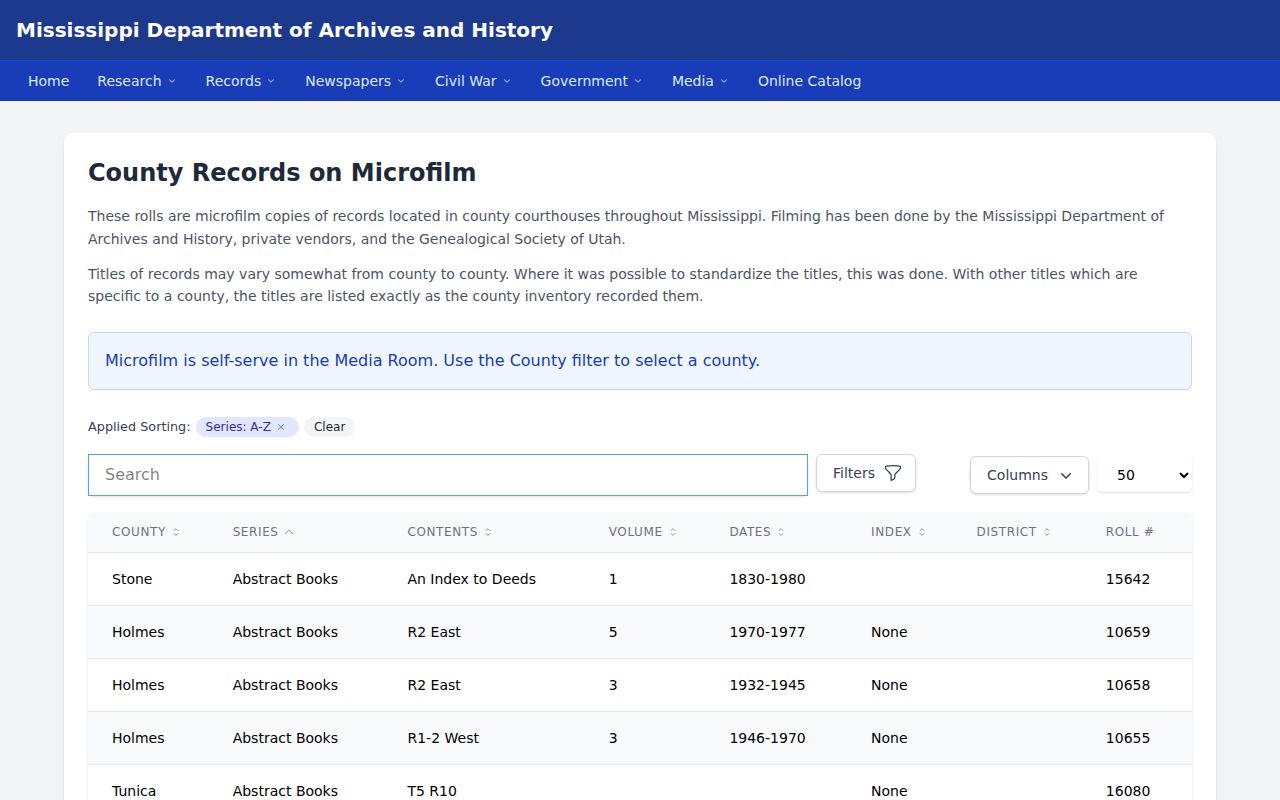
Work from the county and series filters first. Check the dates and roll notes before you trust a reel. A reel listed in the index does not guarantee a parcel's full chain of title. Confirm whether the index alone is on file or whether the deed itself is included.
FamilySearch offers a Mississippi wills and deeds collection. It supplements both the courthouse and MDAH holdings. County coverage varies, and viewing images may require a free account. The wills and deeds collection accepts place and address terms among its search options. That makes it a natural next stop for a past residents search. The record may be neither online nor on the archive list. Then write to the Chancery Clerk and request the identifiable record by name.
The Mississippi Public Records Act, Miss. Code Ann. §§25-61-1 through 25-61-19 sets the clock. An office with written procedures should respond within seven working days. Ordinary production should not exceed fourteen working days absent agreement. Fees are limited to actual cost, and the office may ask for advance payment.
Mississippi Past Residents by Address
A deed names the owner, not every occupant. For an address-to-name clue, historical reverse directories fill the gap for selected years. They are sometimes called criss-cross volumes. Harrison County Library holds Mississippi Coast Cross Reference Directory runs. The years cover 1986–95, 1997, 2000–01, and 2004. The same shelf covers Biloxi, Gulfport, Pascagoula/Moss Point, Bay St. Louis/Waveland, and other Coast communities in different editions.
Search one known year first. Then compare the closest earlier and later volumes. Keep the exact printed street form. Note whether the entry names a person, a business, or something else entirely. Never assume a resident stayed put through years with no surviving book. The Mississippi city directory collections page lists the local catalog and shelf details. Here the collection is just one step in a single parcel's history.
Treat a reverse directory as a dated snapshot. A name can vanish for many reasons. It could be a move, a death, or a listing that never happened. It could also be a book that did not survive. Compare the entry against the census year and family records. Do this before concluding anything about who lived there.
Mississippi Previous Residents and Sanborn Maps
Sanborn fire-insurance maps place a structure on an old street grid. They show a building's footprint, material, and use. They do not name residents. The Library of Congress holds a public-domain 1904 Jackson set of 25 sheets. Other cities carry their own dates and coverage. Find the street and block on a sheet. Then pair the map date with a directory, census, and deed rather than treating it as an occupant list.
Map labels can resolve a street-number change or identify a building that no longer stands. A map year sitting between two deeds is only a physical landmark. The Library of Congress 1904 Jackson Sanborn map is one confirmed local example.
Mississippi Previous Resident Probate Records
Address-keyed permits can date work at a property. Jackson's building-permit office may record the address, permit type and status. It may also list application or issue date, work description, contractor, and valuation. Other cities use different systems, and Mississippi publishes no statewide permit index. A permit names an applicant or contractor when those fields exist. It does not prove who lived there.
For a person who left or died, a Chancery Clerk probate file may connect the deceased with an executor, heirs, inventory, residence, and a later deed. FamilySearch's Mississippi probate collection covers a title range of 1781–1930, with most images falling in 1850–1930, and county and image access vary. MDAH newspaper microfilm and cemetery indexes can add an obituary, a burial place, or a family clue. Its genealogy resources describe the archive and cemetery channels. Confirm the identity across dates and relatives before attaching any record to the address.
Begin with the Mississippi probate records or MDAH's newspaper holdings browser. Then ask the local custodian for any permit or case record tied to the property.
Mississippi Previous Residents and Address Gaps
A street number alone can fail you. Streets get renamed, parcels get split, and town boundaries move. No specific Mississippi street-renumbering year is documented here. Keep the legal description and parcel identifier beside each address. Also try the subdivision, lot and block, section-township-range, the older street name, and the county shown on the record. Some Mississippi counties have more than one judicial district. So the right office can depend on the district as well as the county.
The Secretary of State's municipal and county document search can surface annexation or charter material. Check it before you assume a postal city matches the municipal boundary. MDAH's county inventory can explain missing older files. That is because courthouse fire and damage history differs by place. The goal is a sourced trail through each change, not a guessed address filling a gap.
Use the Mississippi municipal and county document search to look for local government records. Those records may explain a boundary or place-name change.
Previous Residents in Census Years
Match a city directory from roughly the same year as the address you know. Then pull the closest census schedule that is open to the public. The directory gives a street or household clue for that year. The census, in turn, lists the household members and their ages at the enumeration date.
Streets without numbers were common. A house number may be missing. Or the street may have been renamed. The enumeration district map and the street order the enumerator followed can still lead you to the right schedule.
- Choose a likely directory year and copy the address exactly as printed.
- Find the closest public census year, then use the enumeration district and street index to locate the household.
- Compare names, ages, birthplace, and family relationships instead of relying on one matching surname.
- Check another directory or a probate, newspaper, or cemetery record to test the date between census schedules.
Federal census schedules are public through 1950 under the 72-year rule. The 1890 federal census was mostly destroyed, which leaves a well-known hole. Mississippi's own state census returns for 1818–1880 can add earlier context for a past-residents search. County tax rolls for 1818–1902 can help too. Both vary in completeness. Neither is a modern street-by-street household list like a current street directory.
Use a past address for family history, estate research, or plain personal interest. A record trail is never a reason to track anyone. It is never a reason to threaten or harass a person who may still be living.
Lawful use. Keep Mississippi previous-resident research to lawful house-history, family-history, and personal purposes. Do not use names or addresses to follow, intimidate, or harm a living person.