
Find Mississippi Residents
A Mississippi residents directory is really a map to separate records. There is no master list. Property questions begin with the county parcel roll. A voter checks registration through the Secretary of State. Family-history work starts with the year and place. The old street directory or census prints that detail. These records were built for different purposes. So each gives only one slice of the picture. With 82 counties, Mississippi splits its public tools between state agencies and county custodians.
For a current address, treat the parcel as a lead. Keep the owner's mailing address separate from the land's physical address. For a court filing, identify the court and county first. An old street name, a different spelling, or a married name may call for a second resident lookup. These habits let a residents directory answer a narrow question. One record alone is not proof of who lives in a home.
- Write down the county and the record date. Mississippi land records belong to the county where the property sits.
- Search the county assessor or GIS by address, parcel number, or owner name. Save the legal description as well as the mailing and situs addresses.
- Use the deed index or court portal for the exact event you need, then ask the clerk for an image or certified copy if needed.
- For a past household, search the library or archive catalog by town and year, then compare the result with a census, newspaper, or probate file.
- If a record is not online, contact the custodian or send a specific request under the Mississippi Public Records Act. Do not ask an office to create a new record or infer an answer.
Mississippi Resident Records Offices
Mississippi offices divide their work by record type. The county Chancery Clerk holds land, probate, marriage, and divorce files. The Circuit Clerk handles voter registration and circuit or county-court material. Assessors and GIS offices keep the parcel data. At the state level, the Secretary of State runs election and business tools. The Department of Health holds vital records. The Department of Archives and History keeps historic materials. The Mississippi State and County Directory routes you to the right local office. Some counties keep more than one judicial-district seat.
Mississippi Archives
Statewide historic records and microfilm
Search by county, record series, or town.
Mississippi Vital Records
222 Marketridge Drive
Ridgeland, MS 39157
601-206-8200
Mississippi Elections
401 Mississippi Street
Jackson, MS 39201
601-576-2550
Historical copies held at state level come through the MDAH catalog and its microfilm tools. A current family event goes to MSDH with an eligible application. For a county deed or local case, the county clerk remains the record holder.
County Offices Hold Mississippi Land Records
Mississippi has no single statewide deed index. The Chancery Clerk in the county where land lies is the official source for deeds, plats, and liens. That office also holds probate files and many marriage and divorce records. The Circuit Clerk handles voter registration and many court files. Some counties have more than one judicial district. The right courthouse can depend on the district. It can also depend on the county name.
The statewide SOS State and County Directory is the routing tool. Use it for finding a records office. It links readers to local clerks and assessors. When a record is not indexed online, call the clerk about public terminals, old book indexes, and copy fees. Ask about certified copies too. A deed request should name the county, the parties, the property, and the record type. Add a likely date range.
Search Mississippi Tax-Forfeited Land
The Secretary of State's Tax-Forfeited Lands search is a handy statewide discovery tool. It covers tax-forfeited property and auction activity only. It is not the ordinary county land roll. A result can point to an assessed owner or parcel. But no result does not mean the county has no deed or tax record. For current parcels, county assessor sites remain the first stop.
The search offers several ways to narrow a property record. County is required, and most other fields are optional. The state advises short terms. Too many filters can hide a match in the land roll.
| Search Field | What to Enter | Use and Limit |
|---|---|---|
| County | One or more counties | Required; multiple counties may be selected. |
| Address | Street number, name, city, ZIP | Contains or exact modes are available. |
| Parcel or PPIN | County identifier | Formats vary by county. |
| Assessed owner | Name or partial name | Contains or exact mode; an owner is not always an occupant. |
| Legal description | Lot, block, or land terms | Useful when a street name has changed. |
| Section, township, range | Land-location terms | Township and range include direction choices. |
| ZIP or subdivision | Postal code or subdivision name | These filters do not define city limits. |
- Parcel
- A county identifier for a piece of land.
- Situs address
- The physical location of the parcel.
- Mailing address
- Where the owner receives tax notices; it may be somewhere else.
- Legal description
- The land description used in the deed or plat, such as a lot and block.
Current Mississippi Resident Directories
Current Mississippi records are partial lists built for separate purposes. A tax roll names assessed owners, not everyone at a parcel. A voter file holds registration records under state rules. A business filing names people who act for an organization. A court docket records a case, not an address book. The sources below are starting points. Each carries its own access limits.
| Source | Who It Lists | Keeper | Access |
|---|---|---|---|
| County tax roll and GIS | Assessed owner and parcel | County Tax Assessor | County portal, map, or counter |
| Voter verification and file | Voter’s own registration or eligible file fields | Secretary of State and Circuit Clerk | Self-service or governed file access |
| Deed and court indexes | Recorded parties or named case parties | Chancery or Circuit Clerk | County index, clerk terminal, or request |
| Business and license searches | Officers, agents, or credential holders | State agencies and boards | Public lookup; document access varies |
| City and community records | Officials, permit applicants, or listed organization contacts | Municipal clerk or planning office | Local directory or records request |
When the question narrows from a whole county to one person, compare separate records by date and county. A voter's own confirmation, a deed, and a court docket each answer a different question, as the Mississippi resident lookup process explains. None is a complete list of current residents.
Mississippi Voter Records Stay Split
Mississippi keeps voter access in two pieces. The Y’all Vote hub from the Secretary of State connects to an authenticated service. There a voter types in details exactly as they appear on the registration record. That is a personal check, not an open resident lookup. If the screen comes back empty, the county Circuit Clerk or the Elections hotline at 1-800-829-6786 is the listed route.
The weekly file program is different. Its statewide rows carry active and inactive registrations, residence and mailing addresses, and ZIP codes. Precinct and district fields, registration dates, status, and last-voted dates are included too. A separate history file adds election name and type. Ballot choices stay private. Mississippi law and SOS rules also hold back date of birth, Social Security number, and driver-license number. Phone and email are held back as well. Treat each row as a dated registration record. It is not proof anyone still lives at that address.
The files serve as a residents directory of sorts. They are drawn from voter rolls rather than property rolls or a street directory.
Mississippi Court Search Has Limits
Mississippi’s courts answer to different clerks. There is no single public search across them. City courts handle local matters, county Circuit Clerks keep many circuit and county-court files, and Chancery Clerks hold the land, divorce, and probate papers. Justice Court access varies county by county. Start with the court that heard the case. Its clerk can tell you about dockets, file images, certified copies, and the local fee.
The MEC/PAMEC portal serves participating courts. Its registration and login screens, though, do not amount to a free statewide party-name browse. Attorney and non-attorney accounts carry an annual fee, and some filings stay limited to a party or attorney of record. The MDAH Court Cases database offers a historical route. Search names or phrases, take the call number, and request the box in the Archival Reading Room. Federal cases in the Northern and Southern Districts run through PACER.
Mississippi Vital Records Have Separate Rules
Vital records in Mississippi follow two things: the custodian and the requester’s eligibility. The Department of Health holds birth and death records from November 1912, plus marriage statistics from 1926 with a 1938–1941 county-clerk exception. Birth access is restricted for 100 years. Death access is restricted for 50. Genealogy copies after those periods are plain paper, not certified certificates.
Eligible applicants need identification and a qualifying relationship or other allowed basis. MSDH lists $17 for the first copy. Another copy in the same order is $6. Mail requests generally take 7–10 business days, and online or phone expedited service is separate. The MSDH Vital Records office in Ridgeland accepts requests in person and by mail, with phone and online routes as well. A divorce verification search can pinpoint the county. The Chancery Clerk there has the decree itself.
Historical Mississippi Resident Directories
No single Mississippi city directory exists. Holdings follow the town, publisher, year, and shelf. MDAH’s catalog lists Jackson Polk volumes from 1954 onward. Selected microfilm years run from 1984/85 through 1995, with microfiche for selected years between 1959 and 1983. Harrison County Library holds Biloxi, Gulfport, Pascagoula, Moss Point, and Coast runs, including address cross-reference volumes from 1986–1995, 1997, 2000–2001, and 2004.
A yearly directory line may give an address, occupation, spouse notation, or business. It is a dated lead, not settled fact. Short forms need the book’s own key. The Mississippi city directory page lists the collection years and how to search them; county and town names matter, since a book can reach suburbs beyond its title.
MDAH Microfilm Bridges Missing Years
Mississippi’s county records mix paper and digital. There is no single statewide online cutoff. The Department of Archives and History holds original county records from 47 counties plus microfilm copied from courthouse books. Its county-records browser shows series, dates, index notes, and roll numbers. A separate pre-1920 inventory shows which office and district held a record. Microfilm is self-serve in the Media Room. Archival boxes need a Reading Room request.
Fire and damage destroyed some courthouse books. MDAH’s examples include Port Gibson in 1839, Sardis in 1904, Sumner in 1908, and Lincoln County records in Brookhaven in 1892, and those losses apply only to the named places. They never erase the whole state. When a Mississippi index shows a gap, work the inventory, the microfilm, FamilySearch images, newspapers, and the local courthouse before calling a missing online hit a missing record.
Business Records Show Public Affiliations
Mississippi keeps its business filings in the Secretary of State STAR portal. It offers organization and individual officer routes plus a UCC track. Basic entity details sit in the open. Full UCC documents may need a subscription or an order. A registered agent, officer, or company address only proves a filed role in a record. Treat it as a business fact rather than a pointer to someone's home. Licensing works on the same logic, and the Mississippi Department of Health professional lookup will take a name, profession, or license number. The Insurance Department runs its own separate license search.
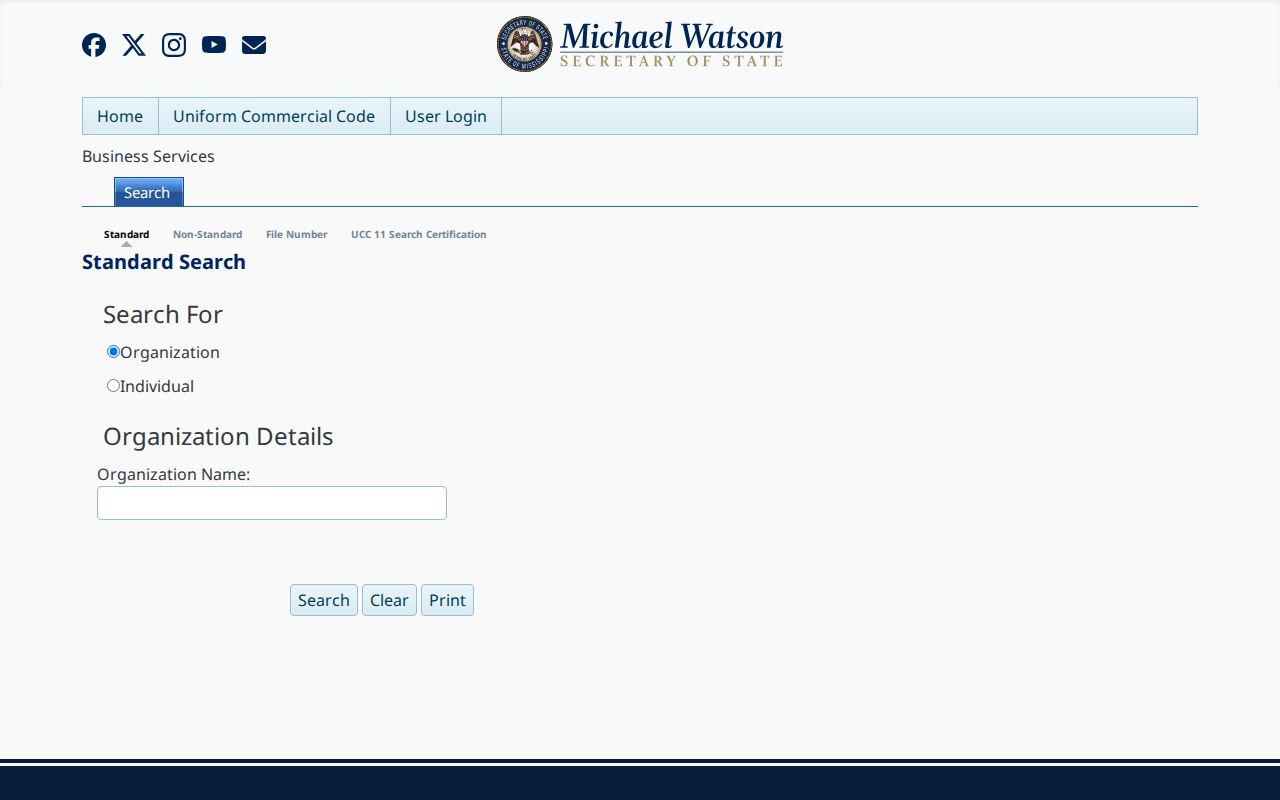
Inside the STAR search screens, the tabs split organizations from individuals, file numbers, and UCC filings. That layout helps when a business name turns up in a deed, a local permit, or an obituary. You may want the filing behind it. Jot down the filing date and type along with the result. Then confirm the record with the agency itself. Start with the Secretary of State STAR portal whenever a business-record lead appears in a directory or property roll.
The Treasury portal presents its search choices plainly, with no list of people living at a Mississippi address.
Treasury Search Finds Unclaimed Property
Mississippi’s Unclaimed Property page from the state Treasury lets anyone search for state-held property and start a claim. A name match there can help reconnect an old account or sort out a family estate. Still, it is not a residents directory. It shows no current home. It also cannot prove that two people sharing a name are the same person. Any claim must include the documents Treasury asks for.
Follow the state’s own Learn, Search, and Claim route. Never pay a stranger who promises to release funds for an advance fee, a gift card, a bank login, or cryptocurrency. Treasury handles every claim itself. A commercial letter is not proof that money is waiting.
Begin at the official Mississippi Treasury Unclaimed Property page to search and file.
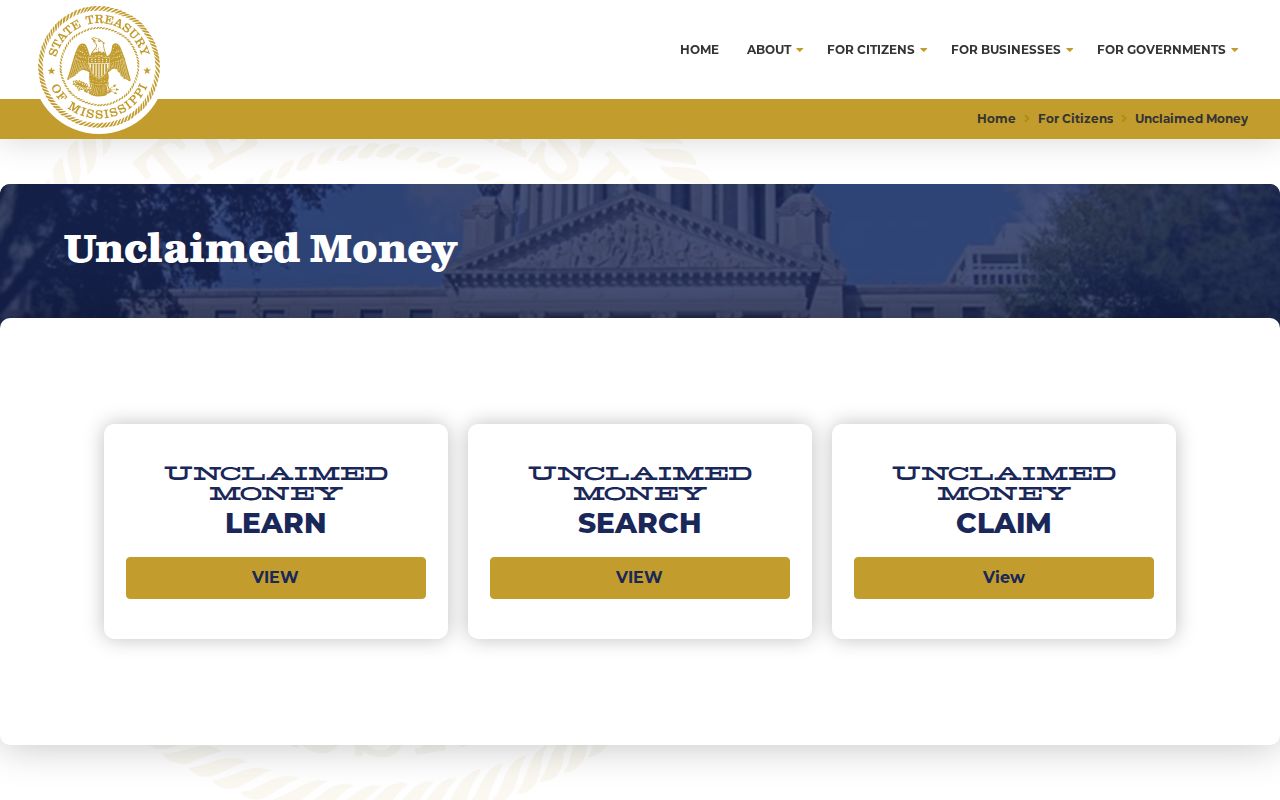
The Treasury page keeps learning, searching, and claiming in separate steps. That layout helps keep a name match in context.
Private Fields Stay Out of Mississippi Records
Mississippi’s Public Records Act opens many existing records. Yet it does not unlock every personal field. Vital certificates, individual tax information, driver-license addresses, protected voter fields, sealed cases, juvenile records, and adoption files each carry their own limits. Certain law-enforcement and judge addresses are shielded too. The Address Confidentiality Program gives eligible survivors a substitute mailing address. Public records must never be combined to uncover a protected home.
An office may hold an identifiable record that is not exempt. Mississippi law grants access through its written procedure. Fees may cover actual search, review, copying, and mailing costs. A custodian need not create a new record or answer a broad question. Ask for an existing file by type, county, party, and date range. Request an estimate before any costly search.
The Secretary of State’s public-record request form shows the contact, description, and cost fields that office expects. Other Mississippi agencies and local governments use their own routes. Send each request to the custodian that actually holds the record.
Lawful use. Public records support family history, civic research, and other lawful personal questions. Do not use a Mississippi resident lookup to stalk, harass, threaten, or expose a protected person.
Quick comparison: a county or state record comes from a named custodian and carries a record date. Commercial people-finder sites blend many sources, sometimes merging two people or keeping a stale address. Neither one counts as proof. Always check the original record first.
| Record path | What it can answer | What it cannot promise |
|---|---|---|
| Official county or state file | A recorded event, parcel, case, license, or registration field | That a named person lives at the address today |
| Commercial compiled result | A possible lead for a name or old address | That its entries are current, complete, or one person |
Verify Mississippi Notices Before Paying
In July 2026 the Secretary of State warned about voter-verification mailers using private QR codes. Mississippi voters should instead open the official Y’all Vote page. They can also call their county Circuit Clerk. The state hotline at 1-800-829-6786 works too. Skip any QR link inside an unexpected notice. The same habit protects every records search. Reach a portal through the state or county’s own page. Then confirm the office name and contact path match.
Apply the same care to deed-copy offers and unclaimed-property letters. Call the Chancery Clerk or Treasury at a number published on its official website. Keep the letter, envelope, date, URL, phone number, and any parcel or claim reference. Set them aside whenever a request looks wrong. A record can be public in Mississippi while the payment demand is still false.